.....


-
YOUR WEALTH
... more
< -
YOUR
WORK
... more -
YOUR
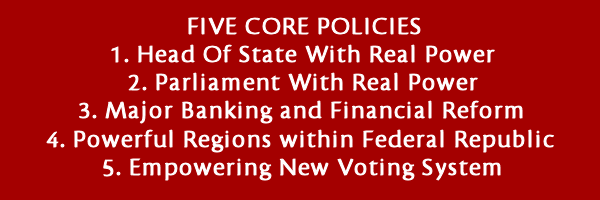
DEMOCRACY. ... more- 1.Vote separately for both Head of State and Parliament. More..
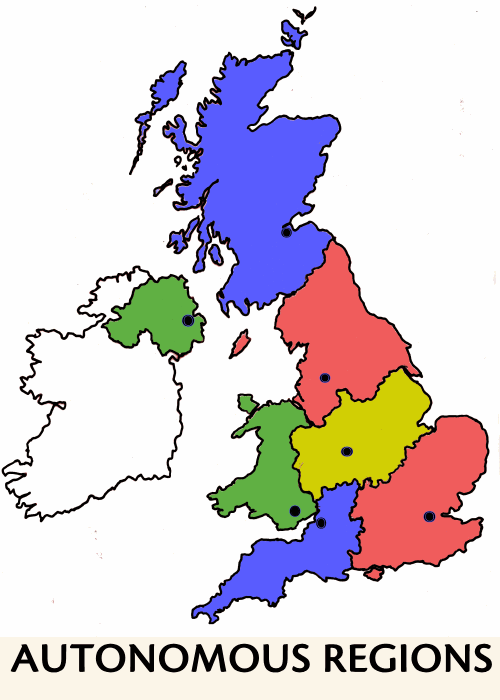
- 2.Autonomous regions bringing real democracy near to you. More..
- 3.Lifetime ban on politicians working for multinationals/finance
- 4.Lifetime ban on civil servants working for multinationals/finance
- 5.Electoral reform to make every single vote count. More..
-
YOUR
NATION
... more -
YOUR
FUTURE
...more


Virtue ....... Freedom ....... Aspiration ....... Wealth ....... Peace
Manifesto Introduction
The party defines itself by the five core policies. So that members and non-members clearly understand what the party stands for, these cannot be changed. At present they are principles the details of which will be decided according to the party constitution
All other policies will be decided according to the constitution
Below is a provisional list of headings for the Mani-festo each with a link to a page
That page contains provisional ideas for discussion.
Read this, as work in progress. Only DRP paid up members can comment and so if you want to have your say:
JOIN THE PARTY AND LEAVE A COMMENT !
A NEW CONSTITUTION FOR BRITAIN
Constitution Design
Executive
House of Commons Senate
Autonomous Regions
Democracy
Judiciary
Constitutional Court Supreme Court
Functions of Government Public Services Board Monetary Policy Board
ECONOMICS
Banking
Finance
Globalization
Monetary reform
TAXATION
Tax havens
Corporation tax
Income tax
Wealth tax
REGIONS
Federal nation
Autonomous regions
INDUSTRY
Skills training
Industry needs
Business development
Export assistance
PUBLIC SERVICES
Health
Education
Utilities
Transport Road Rail Air
Social Housing
Postal Services, Telecommunications
Police
Fire Service
Prisons
Probation Service
Waste/ pollution
FOREIGN AFFAIRS
Europe
Commonwealth
Islamic World
War
Military provision
SOCIETY
Families
Social exclusion
Minorities and race relations,
Citizenship
Economic enfranchisement
Church of England
Civil Society
Deprivation
Youth
Meritocracy
Immigration
Ethical Issues
Humanitarian issues/Animals
NATIONAL PLANNING
National planning strategies
Coordination of regions
Transport
LAW
Human rights
Liberty
Economic rights
Citizenship
Penal reform
Vice
Drugs
Prostitution
Gambling
CULTURE
Arts
Broadcasting/BBC
Press
POLITICS
Political parties
Corruption
Protest
Political philosophy
SPORT/LEISURE
ENERGY
ENVIRONMENT
AGRICULTURE
CEREMONIAL
CIVIL SERVICE
Government departments
Prosecution Service
ISSUES DISCUSSED IN THE NEWSLETTERS NOT LINKED TO THE MANIFESTO
HISTORY
British Republican History
OTHER NATIONS
THATCHER'S
MALIGN LEGACY
The disastrous neoliberal agenda that still dominates all main parties today
2. Thatcher’s Economics. Monetarism
It is a curious fact that in spite of being so heavily influenced by Austrian style libertarianism, Thatcher, in 1980, also signed up fully to one of its foremost rivals – the Chicago school of monetarism lead by Milton Friedman. Although Thatcher is portrayed by her supporters as a clear-eyed, single-minded visionary, the reality is that she was easily influenced by fads. There is no better illustration of this than her embracing of two opposing economic ideas at that same time.
Monetarism was all about state intervention of the type the Austrians shunned. It was predicated on the simple idea that the way to control inflation was to control the money supply. This in turn was based on a very old economic theory: the quantity theory of money, and this tells us that prices in the shops will increase if there is more money in the economy – “too much money chasing too few goods”.
I will not go into the detailed arguments about monetarism here, but suffice it to note that there have been many occasions (e.g. Britain in the noughties) where the money supply boomed and consumer inflation did not. The empirical evidence for monetarism does not exist and in addition the theory is flawed, for if there is more money in the economy it can just circulate more slowly and prices will stay the same.
Thatcher did not see these failings and in the early years of her reign adopted monetarism with gusto. Friedman was overjoyed for this was the first time his academic theories had been fully tested in a real live laboratory (here the laboratory was the British economy). There was an enormous squeeze put on the amount of money in circulation in an effort to keep inflation down which at the time had overtaken the high rate she had inherited. Three things resulted. Firstly the pound took off on the exchange markets (although this was also partly due to the knowledge that the pound was about to become a petro-currency) and secondly, as a result, exporters could not compete as imports flooded in. Thirdly the squeeze on money and government expenditure cut off markets that businesses had formerly depended on. Unemployment took off and the economy tanked.
At this point this conviction politician who was “not for turning” dropped monetarism like a hot brick and continued with the uncontaminated Neo-Liberalism. This left Friedman in the same position as the libertarians complaining that monetarism had not been applied long enough and fully enough. British industry has never recovered from Thatcher’s monetarist experiment.
Leave a comment here
We need your views. Join the debate!
blog comments powered by Disqus
© COPYRIGHT. All content of this website unless otherwise indicated is the copyright of Peter Kellow. You may freely quote and republish content on condition that you acknowledge the author the source and give the link to the website www.democraticrepublicanparty.co.uk
ORDER NEWSLETTER
JOIN THE PARTY
DONATE
PARTY
FACEBOOK

EMBLEMS
CREATING A REPUBLICAN PARTY IN BRITAIN



If you would like a transcript of this website in book form, you will be able to reserve a copy at Amazon shortly either a Kindle or a Paperback version
Price to be advised..
ALL PREVIOUS
NEWSLETTERS
ALL PREVIOUS
BREAKING NEWS