.....


-
YOUR WEALTH
... more
< -
YOUR
WORK
... more -
YOUR
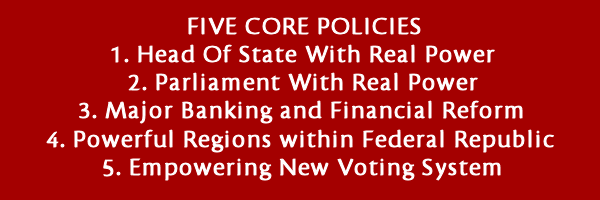
DEMOCRACY. ... more- 1.Vote separately for both Head of State and Parliament. More..
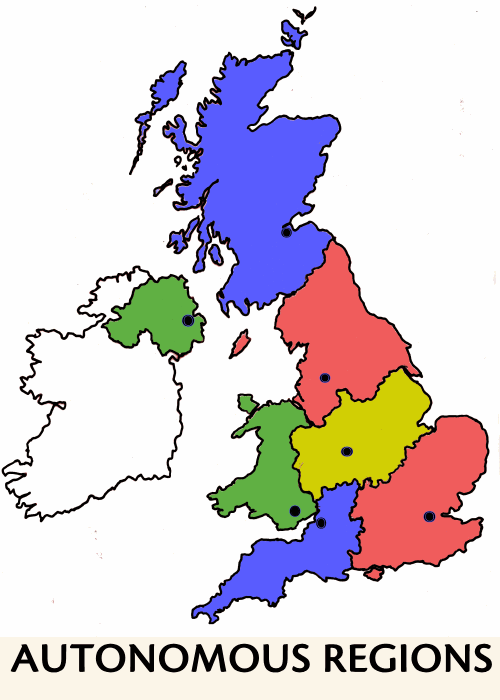
- 2.Autonomous regions bringing real democracy near to you. More..
- 3.Lifetime ban on politicians working for multinationals/finance
- 4.Lifetime ban on civil servants working for multinationals/finance
- 5.Electoral reform to make every single vote count. More..
-
YOUR
NATION
... more -
YOUR
FUTURE
...more


Virtue ....... Freedom ....... Aspiration ....... Wealth ....... Peace
Manifesto Introduction
The party defines itself by the five core policies. So that members and non-members clearly understand what the party stands for, these cannot be changed. At present they are principles the details of which will be decided according to the party constitution
All other policies will be decided according to the constitution
Below is a provisional list of headings for the Mani-festo each with a link to a page
That page contains provisional ideas for discussion.
Read this, as work in progress. Only DRP paid up members can comment and so if you want to have your say:
JOIN THE PARTY AND LEAVE A COMMENT !
A NEW CONSTITUTION FOR BRITAIN
Constitution Design
Executive
House of Commons Senate
Autonomous Regions
Democracy
Judiciary
Constitutional Court Supreme Court
Functions of Government Public Services Board Monetary Policy Board
ECONOMICS
Banking
Finance
Globalization
Monetary reform
TAXATION
Tax havens
Corporation tax
Income tax
Wealth tax
REGIONS
Federal nation
Autonomous regions
INDUSTRY
Skills training
Industry needs
Business development
Export assistance
PUBLIC SERVICES
Health
Education
Utilities
Transport Road Rail Air
Social Housing
Postal Services, Telecommunications
Police
Fire Service
Prisons
Probation Service
Waste/ pollution
FOREIGN AFFAIRS
Europe
Commonwealth
Islamic World
War
Military provision
SOCIETY
Families
Social exclusion
Minorities and race relations,
Citizenship
Economic enfranchisement
Church of England
Civil Society
Deprivation
Youth
Meritocracy
Immigration
Ethical Issues
Humanitarian issues/Animals
NATIONAL PLANNING
National planning strategies
Coordination of regions
Transport
LAW
Human rights
Liberty
Economic rights
Citizenship
Penal reform
Vice
Drugs
Prostitution
Gambling
CULTURE
Arts
Broadcasting/BBC
Press
POLITICS
Political parties
Corruption
Protest
Political philosophy
SPORT/LEISURE
ENERGY
ENVIRONMENT
AGRICULTURE
CEREMONIAL
CIVIL SERVICE
Government departments
Prosecution Service
ISSUES DISCUSSED IN THE NEWSLETTERS NOT LINKED TO THE MANIFESTO
HISTORY
British Republican History
OTHER NATIONS
I. Republicanism
1.Ideal of Republicanism defined by:
- Civil Society comprising Civil Institutions (Government or Chartered) whose members are appointed according to merit, qualification or achievement
- Different Powers or Functions of Government are defined (such as Executive, Legislature or Judiciary), and these are embodied in separate, independent Government Institutions (which may be Civil or Democratic Institutions).
- Checks and Balances operating between the Institutions embodying these Functions
- Regional/Local Government Civil and Democratic Institutions to balance with the center
- Public Services (including the Military) provided for the benefit of the nation's people, organisations, businesses and natural resources, and also to some extent, great or small, to contribute to the benefit of those things anywhere in the world
Thatcher had a well advertised aversion to any Civil Institution of the kind that make up the Civil Society referred to in the First Aspect* of the First Ideal of Republicanism.
Thatcher's comment that "there is no such thing as society" refers as much as anything to the Civil Society. For example, she successfully undermined the status of Universities by abolishing tenure for lecturers, she diluted the role of the Civil Service in government and undermined the role of the BBC. Attempts to reduce the status of the legal profession were less successful.
The desire is always the same: to force Institutions to operate more like private companies thereby undermining their institutional role and turning them into a more pliable constituencies. This is done under the Populist pretexts of "opening up" or combating "elitism" and "restrictive practices".
The effect is always the same: by gnawing away at the Civil Society, the power of the Executive is enhanced. There is also the effect that the richness of life is eroded as more and more activity becomes reduced to the singular pursuit of self-interest.
New Labour continued this trend and a very recent example is set out in the Green Paper that would allow non-solicitors to own solicitors' practice, so renewing the attack on the independence of the legal profession.
And the New Labour proliferation of Quangos is sure sign of the Executive trying gain control over the Institutions that make up the Civil Society.
In respect of the Fourth Aspect* of the First Ideal, Central Government has long sought to undermine the Local Authorities by manipulating their spending and usurping their power.
For instance, New Labour planning legislation tends to sideline elected planning committee members emphasising the role of direct "consultation" with the people that elected them. And New Labour quango, CABE, has been used to bully committee members into accepting an arbitrary "expert" opinion on planning proposals.
Leave a comment here
We need your views. Join the debate!
blog comments powered by Disqus
© COPYRIGHT. All content of this website unless otherwise indicated is the copyright of Peter Kellow. You may freely quote and republish content on condition that you acknowledge the author the source and give the link to the website www.democraticrepublicanparty.co.uk
ORDER NEWSLETTER
JOIN THE PARTY
DONATE
PARTY
FACEBOOK

EMBLEMS
CREATING A REPUBLICAN PARTY IN BRITAIN



If you would like a transcript of this website in book form, you will be able to reserve a copy at Amazon shortly either a Kindle or a Paperback version
Price to be advised..
ALL PREVIOUS
NEWSLETTERS
ALL PREVIOUS
BREAKING NEWS