.....


-
YOUR WEALTH
... more
< -
YOUR
WORK
... more -
YOUR
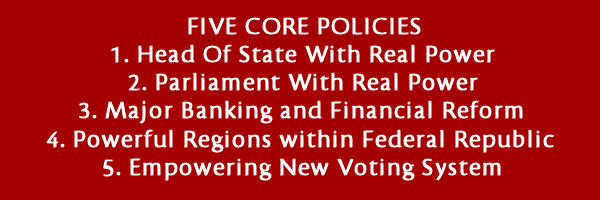
DEMOCRACY. ... more- 1.Vote separately for both Head of State and Parliament. More..
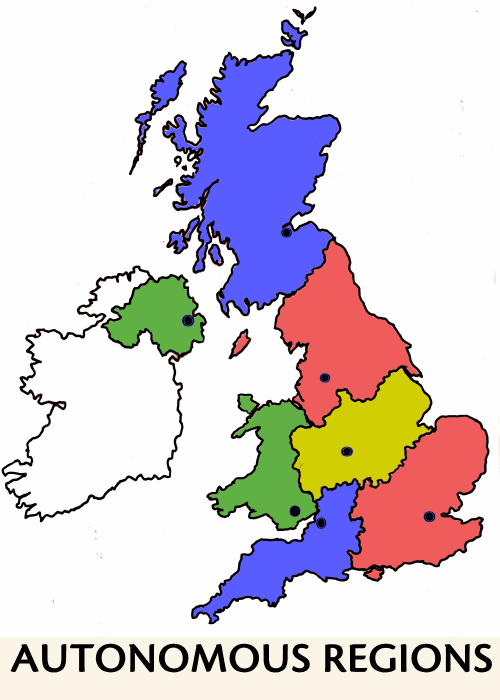
- 2.Autonomous regions bringing real democracy near to you. More..
- 3.Lifetime ban on politicians working for multinationals/finance
- 4.Lifetime ban on civil servants working for multinationals/finance
- 5.Electoral reform to make every single vote count. More..
-
YOUR
NATION
... more -
YOUR
FUTURE
...more


Virtue ....... Freedom ....... Aspiration ....... Wealth ....... Peace
Manifesto Introduction
The party defines itself by the five core policies. So that members and non-members clearly understand what the party stands for, these cannot be changed. At present they are principles the details of which will be decided according to the party constitution
All other policies will be decided according to the constitution
Below is a provisional list of headings for the Mani-festo each with a link to a page
That page contains provisional ideas for discussion.
Read this, as work in progress. Only DRP paid up members can comment and so if you want to have your say:
JOIN THE PARTY AND LEAVE A COMMENT !
A NEW CONSTITUTION FOR BRITAIN
Constitution Design
Executive
House of Commons Senate
Autonomous Regions
Democracy
Judiciary
Constitutional Court Supreme Court
Functions of Government Public Services Board Monetary Policy Board
ECONOMICS
Banking
Finance
Globalization
Monetary reform
TAXATION
Tax havens
Corporation tax
Income tax
Wealth tax
REGIONS
Federal nation
Autonomous regions
INDUSTRY
Skills training
Industry needs
Business development
Export assistance
PUBLIC SERVICES
Health
Education
Utilities
Transport Road Rail Air
Social Housing
Postal Services, Telecommunications
Police
Fire Service
Prisons
Probation Service
Waste/ pollution
FOREIGN AFFAIRS
Europe
Commonwealth
Islamic World
War
Military provision
SOCIETY
Families
Social exclusion
Minorities and race relations,
Citizenship
Economic enfranchisement
Church of England
Civil Society
Deprivation
Youth
Meritocracy
Immigration
Ethical Issues
Humanitarian issues/Animals
NATIONAL PLANNING
National planning strategies
Coordination of regions
Transport
LAW
Human rights
Liberty
Economic rights
Citizenship
Penal reform
Vice
Drugs
Prostitution
Gambling
CULTURE
Arts
Broadcasting/BBC
Press
POLITICS
Political parties
Corruption
Protest
Political philosophy
SPORT/LEISURE
ENERGY
ENVIRONMENT
AGRICULTURE
CEREMONIAL
CIVIL SERVICE
Government departments
Prosecution Service
ISSUES DISCUSSED IN THE NEWSLETTERS NOT LINKED TO THE MANIFESTO
HISTORY
British Republican History
OTHER NATIONS

One
DEMOCRACY
BETRAYED
The democratic system in Britain is failing. Trust in politics and politicians has plummeted. Voter turnout is at an all time low.
On the other hand, thanks to a long tradition of debate and a great heritage of ideas, democracy as an ideal is very much alive.
But we are reduced to having three main parties all with very much the same message. For many, democracy has been betrayed.
But why is this? How did it happen?
To understand this we should look at the way power actually works in 21st century Britain.
There is a great myth, portrayed in the media and by politicians themselves, which tells us that power lies in the political machinery and, in particular, in Parliament.
This myth tells us that democracy holds the power in society.
But this is false.
It has always been the case that money has had power. This is true of every society throughout history that was not completely closed and authoritarian.
But in our own day, in our own time, money has assumed an unimaginable hold over us.
There now exists a plutocracy that wields the kind of power that dwarfs and ridicules the power of the democratic machinery.
The reason why the power of money has now reached such an extreme is above all due to its international reach, for it is this that puts it above our national political system.
The power of politicians is very largely limited to what happens within the geographical boundaries of their nation state.
They may extend that power through international treaties but this kind of power is limited by what other nations will agree to. They may extend national power through war. But that is a last resort, usually with messy and unpredictable outcomes and always with great suffering.
The people who hold vast amounts of money, however, are not limited to the boundaries of any nation state. The corporations that they own and control have global reach.
They take decisions that affect people and events transcending mere nations.
The result of this is to put our politicians in awe of such power. But, worse than this, the vast wealth of international money can be used to buy political influence. Our politicians sell out to transnational interests that have no concern for Britain except insofar as they can use and exploit her.
You see this in the way, international money subsidises political campaigns. This is not free money. Political favours are expected in return. So national policies are shaped by extra-national concerns,
You see this in the way that when a political career ends, the politician takes up a lucrative position with international finance. The case of Tony Blair sitting on the board of megabank, JP Morgan, is a particularly obscene case of this. International finance rewards its own.
But it is not only the elected representatives in government that are guilty of allowing themselves to by bought.
Our civil servants regularly give up state employment for mega-rewards from international companies. The revolving door between the civil service and global corporations plays a great part in having decisions made that are contrary to the interests of the British people.
But in order to complete the understanding of how our democracy has been corrupted we need to look also to financial services - the banks.
Most are international and so are included in any discussion of global megacorps. But even an entirely British financial concern (and the DRP proposes there should be many) can exert a malign influence of politicians.
The reason for this is that the concerns of finance should never be primary. Banks are there purely to serve the rest of industry. Their own interests should not dictate decisions - as they do now
So what is to be done?
In the first place we should understand that the power of the global and financial corporations depends on politicians doing their begging. For all their ability to manipulate, to threaten and to bribe, ultimately it is national governments that decide.
Yes, ultimately democracy has the power. And the people have the power through their democratic processes.
The failure of democracy in Britain does not come from the democratic system itself, but from the leaders its produces.
Those leaders could put in place constitutional provisions that would guard against the worst excesses of international corporate power. None of the main political parties has any interest in such measure.
But the Democratic Republican Party does.
We will pass into the new republican constitution a provision that will exclude any person who has served as an elected politician or in a high level in the civil service from ever during their lifetime taking any employment or gifts from an international company or a financial services company.
Except in the case of financial companies, this provision will not be extended to companies wholly owned and wholly manufacturing within Britain. An interchange between our own productive industry and our government is only normal, natural and healthy.
Such interchanges by their nature involve only British interests. They may be partial interests and probably will be. We cannot expect private companies to be heavily focused on the broad national interest in all their dealings. Businesses don’t work like that.
Nevertheless, the interests of a wholly British company are still British interests.
This is not to say that all international and financial corporations are all bad, and that every decision they make is malign. This is not to say that their activities should be unduly curbed in Britain.
Some companies with international reach are largely British and we should be justly proud of them.
Neither is the DRP saying that such companies should not have political influence, for it is only right that the government should take account of the interests of our major companies.
The difference is the following: that influence cannot be bought.
This will restore the balance between democratic and money power. When politicians and civil servants make decisions about the future of the country it will not be with an eye to future or present personal gain for they will be banned from receiving any (on penalty of prison and loss of pension entitlements).
They will have to make decisions on the basis of their best objective judgments. The rewards for good service and good decision making will still be there in the form of institutional appointments and indeed contact with wholly-owned non-financial British companies.
This ban will become to be seen as an asset not a constraint.
It will benefit the economy by putting British interests before those of wholly international concerns
It will promote a healthy and honest democracy of which all can be proud to be a part.
It will restore trust in our politicians.
Leave a comment here
We need your views. Join the debate!
blog comments powered by Disqus
© COPYRIGHT. All content of this website unless otherwise indicated is the copyright of Peter Kellow. You may freely quote and republish content on condition that you acknowledge the author the source and give the link to the website www.democraticrepublicanparty.co.uk
ORDER NEWSLETTER
JOIN THE PARTY
DONATE
PARTY
FACEBOOK

EMBLEMS
CREATING A REPUBLICAN PARTY IN BRITAIN

If you would like a transcript of this website in book form, you will be able to reserve a copy at Amazon shortly either a Kindle or a Paperback version
Price to be advised..
ALL PREVIOUS
NEWSLETTERS
ALL PREVIOUS
BREAKING NEWS